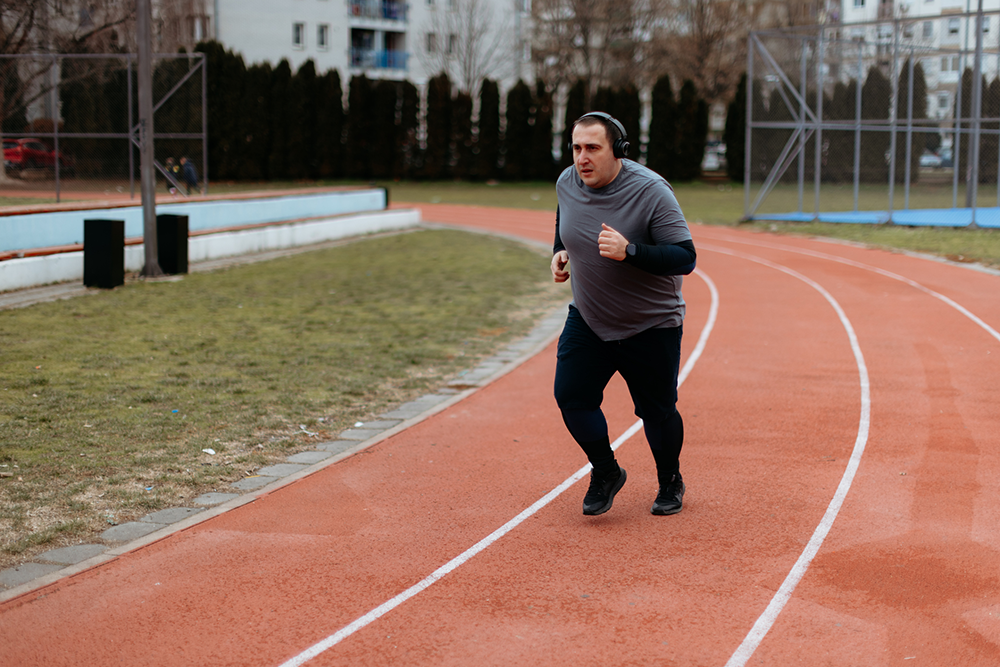
Fair warning: Your first month or two of running will likely be tough.
How it started. You think to yourself, “I’m going to become a runner.” You buy some super-cushioned shoes. You download a training app. You pick a route around your neighborhood that looks easy enough (from the comfort of your couch). You tell your spouse and friends about your plans, make sure they’re supportive.
How it’s going. You go for your first run and feel physically wrecked. Your calves hurt. You feel a lingering stitch in your side. You can barely catch your breath. Your “easy route” has you thinking of calling an Uber. You start wondering whether other runners know something you don’t, or whether they’re all simply better at pretending this is enjoyable.
If any of that sounds familiar, you’re probably having a normal first month as a runner.
The First Few Weeks Are Often the Hardest
A lot of people quit running too soon. They invest in some new gear, get in a few miles, discover it’s hard, and decide they’re just not cut out for it.
But let’s nip that nonsense in the bud. Your first couple of weeks as a runner might feel pretty terrible. That’s because you’re doing real work, but you’re not yet seeing the benefits. Your body has not yet adapted. Every run can feel like hostile negotiations between the version of you who wanted to start running and the version of you currently wondering how a single mile could feel so … damned … long.
The trick — besides embracing the suck because you know it’s coming — is to have patience and give yourself grace. Most runners who stick with it eventually reach a point where running becomes more familiar and less distressing. That doesn’t mean every run becomes easy, but it does mean running starts to feel less like something to endure and more like something your body understands.
Your Body Needs Time to Catch Up
Running feels hard at first because several of your body’s systems are adapting at once. Your heart is learning to pump blood more efficiently. Your lungs are getting used to sustained aerobic effort. Your legs are adjusting to repeated impact. Your tendons, ligaments, and joints are being asked to tolerate a level of movement they may not have dealt with in a while, if ever.
The really frustrating part is these systems usually don’t adapt at the same speed. One day your breathing may feel better but your legs feel heavy. Another day, your legs may feel fine but your lungs just can’t seem to get enough oxygen. Some days, everything feels off, and you may wonder whether the previous week of running somehow made you worse.
Trust me: It probably didn’t. And trust me: This is all normal.
Progress in the first month tends to arrive in random little bumps. You recover a little faster. You run a little farther before needing to walk. The same hill feels slightly less insurmountable. These changes may not seem dramatic, but they’re signs your body is adjusting to the new activity.
That said, pain is different. Sharp pain — pain that changes your gait, gets worse as you continue, or doesn’t improve with rest — deserves professional attention. So do symptoms like chest pain, dizziness, fainting, or unusual shortness of breath. Running is supposed to feel challenging, but it shouldn’t feel dangerous.
The Emotional Part Is Real Too
While most people focus on the physical side of running, the mental and emotional deserves attention. During the first month, you may feel excited one day and completely discouraged the next. You may finish one run proud of yourself and spend the next one wondering how your fitness somehow disappeared overnight.
You may hear yourself saying things like:
- “I’m way too slow. I’ll never be a real runner.”
- “Fat people don’t run!”
- “I shouldn’t have to walk this much.”
- “Everyone who sees me is judging me. I might as well quit.”
- “I look ridiculous.”
The truth is, most people aren’t even giving you a second look. They’re thinking about traffic, dinner, or whatever’s bugging them at work or home. Those who do pay attention are more likely to think, “Wow, I could never do that,” rather than, “That person shouldn’t be running.”
This is where small victories matter. When you run a little farther than last week, celebrate that victory. When you drag yourself out the door when you don’t feel like it, give yourself a little high five. Those moments prove you’re developing the running habit, even if you still feel new and awkward.
In the words of Kara Lawson, head coach for the Duke women’s basketball team and the U.S. women’s national team, “We all wait in life for things to get easier. It will never get easier. What happens is you handle hard better.” Robin Arzón, VP of fitness programming at Peloton, puts it a different way: “It doesn’t get easier. You just get stronger.”
It’ll happen. It might take longer than you want it to, but it’ll happen.
Use the Right Standard
One of the easiest ways to become discouraged is to compare yourself to people who have been running for years. Their easy pace may be three minutes faster than your hard pace. Their “short” Wednesday run may be twice as long as your weekend long run. They might casually drop phrases like, “an easy 10 miles” or “just a half marathon.”
That is not the right standard for your first month. Regardless of your level of experience as a runner, the only valid measuring stick is comparing you to you.
Are you becoming slightly more consistent, slightly more confident? Are you more capable than when you started? Can you run a little longer before walking? Are you recovering faster? Does the same route feel a little less impossible?
The goal of the first month is not to become an Olympic athlete. It’s to become someone who keeps running in the second month.
What Is Waiting on the Other Side
At some point, and usually without you even noticing, running begins to feel different. You head out for some “junk miles” and realize you’re not counting every minute until it ends. Your breathing settles in. Your legs start to cooperate. You still finish tired, but in a way that’s more satisfying than discouraging.
That moment comes at different times for different people. For some, it happens after a few weeks. For others, it takes longer. But it usually arrives gradually, not as a dramatic transformation. One day, you find yourself uttering the phrase “an easy 10 miles,” and you look at yourself in the mirror and ask, “What have I become?”
A runner, that’s what. Celebrate it!
So yes, the first month is not always pleasant, but it’s also the beginning of a process. If you can stay patient long enough for your body to adapt and your confidence to catch up, you may eventually discover the thing you once suffered through has become something you actually look forward to.
Not every day, of course. Let’s not get carried away. But a lot of the time.
No responses yet